When a Tradition Changes Hands
When a tradition changes hands, see how a family can adapt a spring meal while preserving its shared purpose, familiar cues and room for new memories.
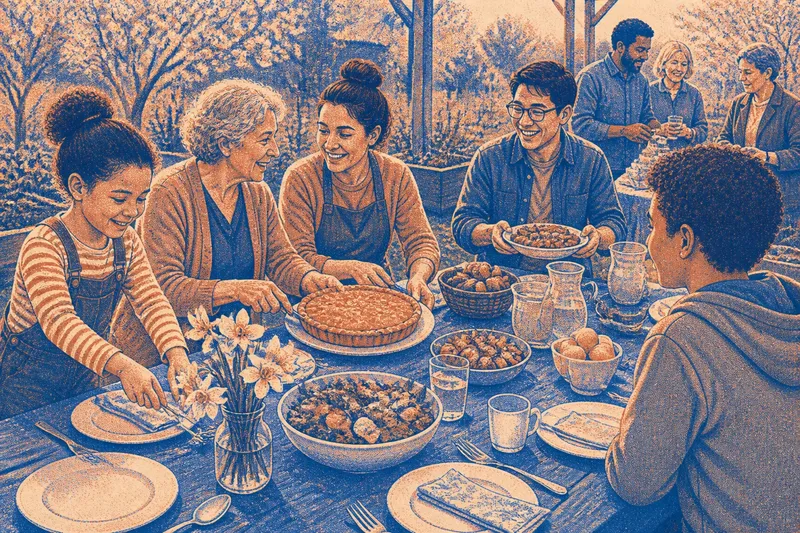
Can a tradition still feel like itself after someone else takes charge? When a tradition changes hands, the answer often lies in what people keep doing together, not in whether every detail stays unchanged. Imagine a family’s annual spring meal moving from an older relative’s kitchen to a community garden: the table looks different, but the gathering may still carry familiar meaning.
Traditions are practices people recognise and pass on, not sealed objects that must remain untouched. To understand a handover, notice what changes, what people choose to retain and how they explain the practice to one another. The aim is not to declare a new version authentic or inauthentic, but to see how meaning travels through adaptation.
A practical problem can prompt a handover
In this invented family, Mara has long hosted a spring meal for her siblings, their children and a few neighbours. The gathering marks the first weekend when the garden is ready for eating outdoors. Mara makes a savoury pie from her aunt’s recipe, lays out a blue cloth and invites everyone to bring something for the table.
As younger relatives raise children and work varied hours, the arrangement becomes difficult. Mara’s kitchen is too small for the group, and some relatives cannot arrive early to help cook. One year, the family skips the gathering. The pause makes the choice clear: insisting on the old format could mean the meal no longer happens.
Rather than treating inconvenience as proof that the tradition has lost its importance, the family asks what the meal does for them. In this imagined situation, they name welcoming new partners, catching up after winter and giving children a familiar role in preparing for spring. Those purposes suggest what they might carry forward, without prescribing one correct format.
People identify the details that carry meaning
The family talks about what matters before deciding what may change. Mara says making the pie reminds her of her aunt, though she is unsure everyone needs to make it from scratch. A cousin values the blue cloth because it appears only for this meal. A child remembers being allowed to arrange the serving spoons.
These details carry different kinds of meaning. The pie connects the gathering to a person and a remembered skill; the cloth marks the occasion; the child’s task makes participation tangible. None has to matter equally to everyone. New people can bring their own associations as they join.
To keep the conversation grounded, the family sorts its memories into three loose groups:
- Purpose: gathering to welcome spring and see one another.
- Recognisable signals: the blue cloth, shared food and an invitation to contribute.
- Flexible arrangements: the host, venue, menu and timing.
This is a conversation aid, not a test every tradition must pass. Another family might treat a recipe as central and the cloth as ordinary. The people involved are best placed to explain their own attachments.
A new version can keep familiar cues
The younger relatives suggest meeting at a community garden with a covered table. They keep the spring timing and ask everyone to bring one dish or drink. Mara prepares the pie with a niece, using bought pastry to make cooking manageable. A nephew brings a vegetable tart that suits his dietary needs.
The result is a negotiated version, not a simple swap. The meal still gathers people around shared food, but responsibility is spread out and the setting is no longer Mara’s kitchen. The pie remains, though its preparation changes; the blue cloth marks the occasion on a public table.
Imagine the family is unsure whether the garden will feel too informal. They bring the cloth, invite the same neighbours and ask the children to arrange the table. The expected observable result is that guests can recognise familiar cues while experiencing a changed setting; if the outdoor space makes conversation awkward, they can discuss another venue for next time. That response treats the first gathering as a chance to notice what works for this group, not as a verdict on the tradition.
A tradition can remain recognisable without reproducing every feature of an earlier occasion. Keeping a recipe or object alone does not necessarily preserve the relationships or purpose attached to it. What people do with those elements together matters.
Participation gives the next generation a stake
A handover involves more than assigning someone else the work. If younger relatives are only told to copy a recipe or book a venue, they inherit a task without necessarily understanding why it matters. Mara helps by telling the story of learning the pie from her aunt, then asking the children what they would like to do.
One child chooses the table setting; another wants to make an invitation for the neighbours. Small jobs turn attendance into contribution. The children do not have to reproduce Mara’s memories to make their own connection to the gathering.
There is no need to demand that everyone feel the same way. Some guests may care most about seeing relatives; others may value the food or seasonal rhythm. People can take part without pretending to share an emotion they do not feel.
It is also reasonable to decline a role. Passing on a tradition is different from assigning unpaid work to the same person year after year. In this invented family, sharing cooking and setting tasks makes the meal easier to arrange; if the work still falls mainly to Mara, the relatives can redistribute it or simplify the menu.
A handover is easier to understand when people explain it
The family can describe its choice plainly: “We still meet for the first spring meal, but now everyone brings a dish and we gather at the garden.” That account recognises continuity and change without claiming the new arrangement is the only proper form.
Care matters even more when a practice belongs to a wider community rather than one family. Before adopting or adapting it, learn who maintains it, what its symbols mean to participants and whether there are boundaries around its use. A practice may carry obligations or sacred meaning for others; affection alone does not settle whether a person has permission to use it.
Even within the invented family, Mara and the children may tell different stories about the meal. She might call the pie its heart; a child might remember being allowed to invite a friend. One memory need not erase the other. Traditions can be carried through overlapping accounts rather than a single authorised explanation.
Questions help people read a changing tradition?
How can you tell whether a changed practice is still the same tradition?
Look for connections that participants themselves recognise, such as a recurring purpose, familiar actions, shared objects or links to earlier gatherings. Not every element needs to remain, and an outside observer cannot settle the question for the people involved.
Does changing a recipe or venue make a tradition less meaningful?
Not by itself. A new venue or simpler recipe may help people keep gathering, while the meaning depends on how participants understand and use the practice. If a change removes something important to some members, that is a reason to talk, not an automatic ruling.
What if younger relatives do not want to continue every part?
Ask what they are willing to carry forward and why, without treating refusal as disrespect. A practice may continue in a smaller form, change hands again or come to rest; honest choice is more meaningful than a performance maintained through resentment.
How should a family handle disagreement about what must stay?
Invite each person to name the memory or value attached to the disputed detail, then consider whether another form could serve a similar purpose. If disagreement remains, the group can decide what to try next without presenting one person’s preference as universal.
The first gathering leaves useful things to notice
After the imagined meal, the family might find the garden lively but hard to hear in, or notice that bringing dishes leaves less time for cooking together. Those observations can shape the next gathering. They do not prove that the old version was better or that the new one has succeeded once and for all.
Mara may want pie-making to remain a shared activity, so the family could arrange a smaller cooking session before the larger meal. The children may prefer to keep setting the table, and a neighbour might suggest a quieter corner of the garden. Each is an option, not a requirement to preserve every component.
Copying a detail simply because it looks traditional from the outside is not worth the effort. If nobody knows why a particular utensil, phrase or schedule is there, ask before making it compulsory. A detail can stay for beauty or pleasure without being presented as an unbroken rule.
When a tradition changes hands, notice whether people can recognise what they are carrying, choose their part in it and make room for new memories. In this family’s invented spring meal, the cloth, pie and shared table offer points of connection; the people around them give those things continuing life.