Pattern, Motif or Emblem? Three Ways to Read a Repeated Image
Learn to tell a pattern from a motif or emblem by noticing what repeats, where it appears and whether a shared meaning is established.
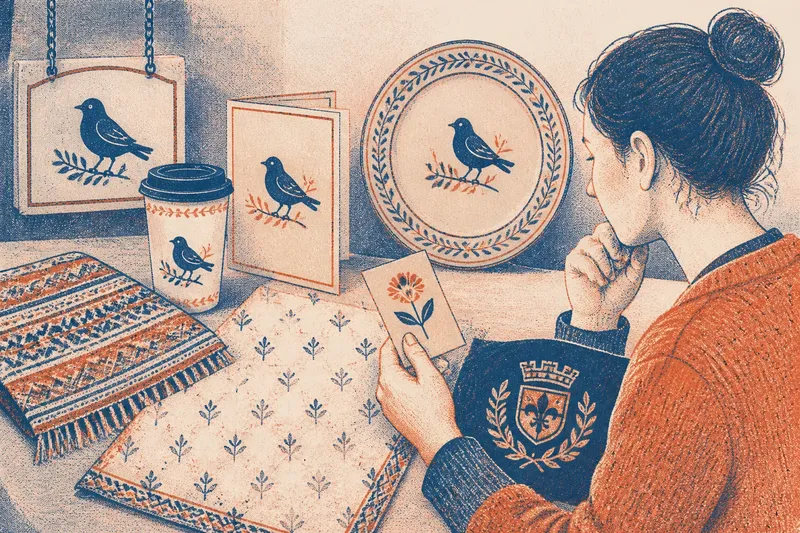
Is a repeated image on a cloth decoration, a motif or a sign of identity? To tell whether you are looking at a pattern, motif or emblem, notice what repeats, where it appears and whether people share an interpretation. The same shape can do different work in different settings.
These terms are not airtight boxes. A repeated leaf may form a pattern across a tablecloth, become a motif in a family of designs, or serve as an emblem when it identifies a group. Read the image in context before deciding what it means.
A pattern organises repetition across a surface
A pattern is chiefly about arrangement. It may repeat a shape, colour, line or combination of elements according to a visible rhythm. Look across the whole surface: the defining feature is often not any one leaf or stripe, but the way the elements relate to one another.
Patterns can be regular or loose. A tiled floor might alternate dark and pale squares; a woven scarf might repeat small diamonds; a hand-painted bowl might carry a less exact ring of strokes. In each case, repetition gives the surface coherence, even if the individual marks do not point to a particular idea.
That does not mean a pattern is meaningless. Its colours, materials and placement may matter to the people who made or use it. But meaning should not be assumed from repetition alone. A zigzag can be a pleasing border, a familiar local design, or something with a particular association; the image itself does not settle the question.
To read a pattern, start with what you can observe:
- Check which element repeats. If one shape, colour or group returns, describe that element; if nothing recurs clearly, describe the overall arrangement instead.
- Check whether the arrangement is even, alternating, mirrored or irregular. If a rhythm is visible, name it; if it is loose, avoid calling it a regular repeat.
- Check whether the design covers the whole object or marks a border, corner or centre. If it occupies a distinct area, describe its placement; otherwise describe it as an all-over design.
- Check whether the design changes when the object turns, folds or is viewed from a distance. If its appearance shifts, note that relationship; if it remains consistent, describe the stable repeat.
- Check the object’s setting for a practical or decorative role. If its use is apparent, mention that context; if not, leave the purpose open rather than guessing.
These observations help distinguish visual organisation from an interpretation you may be tempted to attach to it. A repeated motif can be one ingredient in a pattern; the pattern is the larger arrangement made from it.
A motif is a recognisable image that returns
A motif is a recurring visual element that remains identifiable as it appears in different places or forms. It might be a bird, a key, a sprig, a hand or a particular cluster of lines. Unlike a pattern, a motif can occur only once on an object and still be a motif if it recurs across a collection of objects or designs.
Motifs often help people recognise a family resemblance. A bird might appear on a ceramic plate, a shop sign and a printed wrapper, each time drawn differently. The repeated image links the designs, but it does not by itself tell you whether the bird represents a specific value, organisation or story.
Pay attention to variation. If a shape changes from one appearance to another, ask what remains recognisable: its outline, posture, colour, accompanying objects or position. A motif can be simplified or stylised and still be the same motif. If the resemblance is vague, describe what you see rather than insisting on a name.
Placement gives further clues. A small flower repeated along a sleeve may contribute to a pattern. The same flower placed alone on a pocket, then repeated on a label and a sign, may function as a motif linking several designed things. These roles can overlap: a motif can be repeated to create a pattern.
Imagine a café uses a blue bird on its paper cup, menu and window decal. The bird is a recurring motif across the café’s materials; on the cup, smaller birds might also form a decorative pattern. Unless the café or its community has established a shared interpretation, describe the image as connecting or identifying these designs rather than claiming it represents a particular story.
An emblem points to an established identity or idea
An emblem is an image used to represent a person, group, institution, place, cause or recognised idea. It usually has a more specific social job than a decorative pattern: people use it to identify, distinguish or signal association. A badge, crest, insignia or organisation’s mark can function as an emblem.
The strongest clue is not that the image looks important. It is that people treat it as a sign with a shared reference. The emblem appears in settings where identification matters, such as on a uniform, banner, document or building. Its use may be governed by a group’s conventions, and people may recognise it without needing a written explanation beside it.
Even then, be precise about what is established. A logo may identify an organisation without carrying a widely shared symbolic meaning beyond that connection. A motif may be used as an emblem in one setting and as decoration in another. Do not infer a group’s beliefs from a shape alone; look for the community’s own explanation or clear evidence of how the image is used.
Emblems can also change. A group may adopt an image, revise it or use it in a new setting. The visual form can remain familiar while its associations shift, or the same image can be read differently by insiders and outsiders. A careful description separates the image itself, its identifying function and the interpretations people attach to it.
Ask these questions before naming the image?
When you are unsure which term fits, compare the image’s arrangement, recurrence and use rather than trying to decode it at a glance. The answers below offer a cautious starting point; the same image can have more than one role.
What exactly is repeating?
If the main observation is a regular arrangement across a surface, pattern is a useful starting term. If a recognisable image returns across separate objects or designs, motif may describe its recurring role more clearly.
Where does the image appear?
Placement can show whether the image fills a decorative area, connects a set of designs or identifies a group. A single location is a clue, not proof, so compare how the image is used in other settings.
Do people share a specific interpretation?
An emblem depends on an established reference or identifying use, not merely on a viewer’s personal association. Look for how the relevant people name, display or explain it before assigning a shared meaning.
Could more than one term fit?
Yes. A motif can repeat as a pattern, and an emblem can be rendered as a decorative pattern. Name the role that matters in the particular setting, and mention the overlap if it helps make your description accurate.
Use context to avoid overreading
Interpretation gets shakier when a familiar shape is treated as if it means the same thing everywhere. A star, wave, flower or animal may have different associations in different communities, and some images are simply chosen for their appearance. Begin with the object, its setting and its use; add cultural meaning only when there is a reason to do so.
Ask who made the object, who uses it and where it is displayed. A pattern on a household textile may have been chosen for colour or craft tradition. A similar design on a group’s badge may have an identifying role. If you can ask a maker, wearer or steward, “What does this image mean here?” is more useful than presenting a guess as fact.
It is also worth distinguishing a shared interpretation from a personal response. You might find a repeated wave calming, or associate a particular flower with a relative. That response is real as your own experience, but it does not establish what the design means to its makers or to a wider community.
What is not worth the effort is searching every repeated shape for a hidden code. Sometimes a pattern is there to make a surface lively, a motif to give several objects a family resemblance, or an emblem to help people recognise an organisation. Careful looking is more helpful than inventing a secret explanation.
Describe what you can support
A clear description can state the visible feature first, then its role and any established meaning. For instance: “A row of red diamonds forms a border pattern,” “A small fox recurs across the shop’s packaging as a motif,” or “The club’s badge uses a fox emblem to identify its members.” Each sentence separates observation from interpretation.
If you are unsure, choose cautious language: “appears to be”, “is used as” or “is associated with in this setting”. Those phrases do not weaken the description; they show where the evidence ends. When a label, maker’s note or community explanation gives a specific account, report that account and identify whose interpretation it is.
For pattern, motif or emblem, ask what the image is doing where you see it. Notice the repetition, trace its placement and check whether a shared interpretation is established. That habit makes it easier to appreciate visual design without turning every decoration into a claim about culture.